The Strategic Asset Most Businesses Are Ignoring
Most UK importers have millions of pounds in customs data sitting in their systems. Data that could identify missed duty savings, flag compliance gaps, and give leadership teams supply chain visibility they’ve never had. But nobody’s looking at it.
This article sets out the scale of what sits inside a typical UK import programme, from 25,532 declarable commodity codes to 594,000 active measure conditions, and explains five specific ways that data can drive commercial and compliance decisions at board level.
Whether you lead Finance, Operations, or Customs, the argument here is the same: your customs data already holds answers to questions your business should be asking. You just need the right lens to read it.
Your Customs Data Is a Strategic Asset. You’re Just Not Using It Yet.
Every UK import generates customs data. Every single one. The commodity code, the origin, the duty rate, the preference claimed (or not claimed), the value, the conditions applied. It all gets recorded on CDS declarations. And for most businesses, that’s where it stays. Filed and forgotten.
That’s a bit like having a complete financial audit trail for your entire supply chain and never once looking at it.
We work with importers every day who have millions of pounds in customs data sitting in their systems. Data that could save them money, reduce their risk, and give their leadership team visibility they’ve never had. But nobody’s looking at it, because nobody knows it’s there, or what to do with it.
Here’s the thing: your customs data already holds the answers to questions your board should be asking. You just need to know how to read it.
The scale of what you’re sitting on
To understand why customs data matters, it helps to appreciate the complexity behind it. This isn’t a simple lookup table. The UK Trade Tariff is a living, breathing regulatory dataset that sits behind every import and export declaration.
Here’s what it looks like right now:
See how CAT360 turns your customs data into actionable intelligence
See what is in your own declaration data. CAT360 finds overpaid duty, misclassification and declarant errors, and cites the legal source for every finding.
Start free trialWhat sits inside your customs data
Scale (UK Trade Tariff, April 2026) *
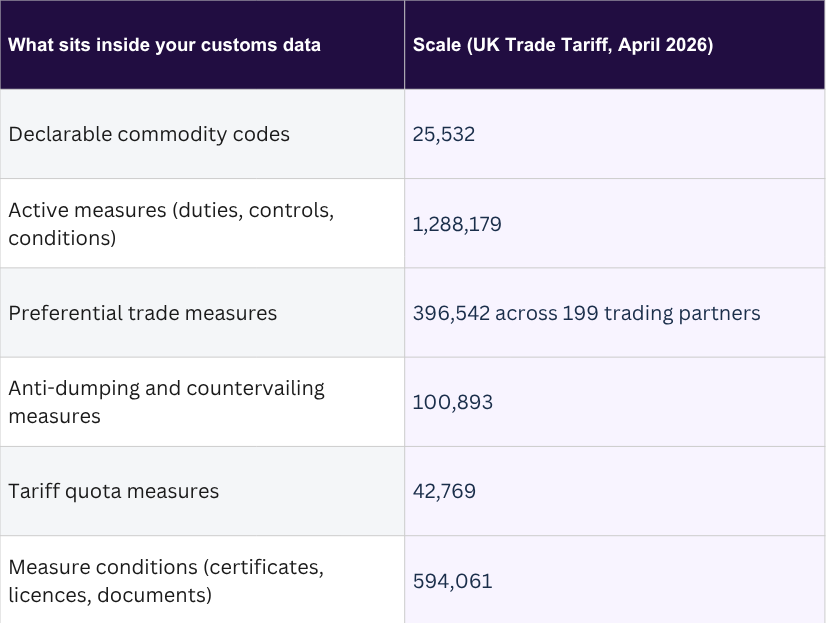
That’s the regulatory landscape your business navigates every time it imports goods. Every commodity code you declare locks you into a specific set of duties, conditions, and compliance requirements. Get it right, and you’re paying exactly what you owe. Get it wrong, and you’re either overpaying or building up a compliance liability you can’t see.
Less than 1% of UK importers have looked at their own customs data. That’s like never checking your bank statements. Brave.
Five things your customs data is trying to tell you
1. You’re probably leaving money on the table
The UK currently has preferential trade agreements covering 199 trading partners, with 396,542 preferential measures across 23,615 commodity codes. These agreements exist to reduce the duty you pay on qualifying imports. But here’s the catch: preferences aren’t applied automatically. Your declarant has to claim them, with the right procedure code, the right origin documentation, and the right proof.
If nobody is checking whether preferences are being claimed correctly, or at all, you could be paying the full MFN rate on goods that qualify for 0.0%. Across a year of imports, that adds up fast.
We’ve seen businesses recover six-figure sums just by auditing their preference utilisation. The data to find those savings was already there. It just needed someone to look.
2. Your classifications might be costing you
Every commodity code carries a specific duty rate. Some codes within the same product family carry very different rates. A classification that’s ‘close enough’ could mean you’re overpaying duty on every shipment or underpaying and building a compliance exposure.
With over 25,500 declarable commodity codes in the UK tariff, each with its own set of measures and conditions, classification accuracy isn’t just a compliance exercise. It’s a financial one. Your customs data can show you where the same product is being classified inconsistently, where codes have changed, and where a review could save you money or reduce risk.
3. You have anti-dumping exposure you don’t know about
There are currently over 100,000 active anti-dumping and countervailing measures in the UK tariff. These are targeted duties on specific goods from specific countries, and they can be substantial, sometimes doubling or tripling the effective duty rate.
If your supply chain sources from countries subject to these measures and your declarations aren’t correctly reflecting that, you’ve got a problem. Either you’re underpaying (and HMRC will eventually notice) or your broker is applying the duty, but nobody in your finance team knows why the landed cost keeps fluctuating.
Your customs data will tell you exactly which of your imports are affected. If you look at it.
4. Your compliance documentation has gaps
Behind the tariff sits a web of conditions: certificates, licences, and documentary requirements that must be met before goods can be imported. Right now, there are 594,000+ active measure conditions in the UK tariff. That’s 594,000 rules about what documentation you need, depending on what you’re importing and where it’s from.
Your customs data can show you which conditions applied to your past declarations, whether the right documents were referenced, and where there are gaps in your compliance trail. If you’re waiting for HMRC to find those gaps for you, you’re playing a game you’re unlikely to win.
5. Your supply chain decisions are flying blind
When your business evaluates a new supplier in a new country, does anyone check the duty implications before signing the contract? The origin of your goods determines which trade agreements apply, which duties you’ll pay, and whether any additional measures (quotas, suspensions, anti-dumping, safeguards) will affect your costs.
Your historical customs data, combined with live tariff intelligence, can model these scenarios in minutes. What would it cost to shift sourcing from China to Vietnam? What if the UK agrees a new trade deal with India? What happens when a quota runs out?
These aren’t hypothetical questions. They’re supply chain strategy. And your customs data is the input.
So why isn’t everyone doing this?
Three reasons, usually.
First, the data is hard to read. CDS declaration data comes as a data dump in Excel. It’s structured for processing, not business intelligence. Analysing it, cleaning it, and making it readable takes specialist knowledge and tooling.
Second, the tariff is complex. Over 1.2 million active measures, constantly changing, cross-referenced by origin, commodity code, and condition. You can’t just drop this into a pivot table and expect insights to appear.
Third, nobody owns it. Customs data falls between teams. Finance sees the duty cost. Logistics sees the shipment. Compliance sees the risk. But nobody has the full picture, because nobody has a tool that brings it all together.
We’ve seen CFOs save seven figures, not by hiring more people, but by seeing their customs data differently.
What changes when you start looking
When you treat customs data as a strategic asset rather than an administrative byproduct, the shift is significant.
Finance gets visibility on duty spend, reclaim opportunities, and landed cost accuracy. No more surprises at quarter end.
Operations gets the data to model sourcing decisions, supplier comparisons, and the impact of tariff changes before they hit the P&L.
Compliance gets an audit trail, classification consistency checks, and a clear picture of documentary gaps, all without building another spreadsheet.
The board gets a risk and opportunity summary they can actually understand, backed by real data, updated continuously.
That’s not a technology pitch. That’s just good governance applied to a dataset that most businesses have been ignoring for years.
Where to start
You don’t need to overhaul your customs operation to start seeing value from your data. You need to start asking the right questions.
How much duty did we pay last year, and how much of it was at preferential rates? Are our commodity codes consistent across declarations? Have we claimed every preference we were entitled to? Where are our biggest exposures?
If you can’t answer those questions today, your customs data can. You just need the right lens.
CAT360 turns your customs data into answers.
We connect to your CDS data and show you what’s hiding in plain sight, missed savings, compliance gaps, classification risks, and opportunities you didn’t know you had. No spreadsheets. No guesswork. Just clarity.
*Tariff statistics sourced from UK Trade Tariff database via CAT360 Customs Data Hub (synced 8 April 2026). Figures represent active measures as of the sync date. Rates and regulations may have changed since this date.

Chief Commercial Officer