
Six Ways Your Spreadsheet Is Working Against You
Customs and logistics teams across the UK are running compliance operations out of spreadsheets. Most already know it’s a problem. What they haven’t fully quantified is what it’s costing them.
This article covers six specific ways spreadsheet-based customs data management creates risk, undermines audit readiness, and leaves duty recovery on the table, and introduces CAT360, Barbourne Brook’s proprietary software built to replace it.
Whether you’re a Customs Manager, Finance Director, or Head of Logistics, the points raised here are directly relevant to how your team is operating today and what that exposure looks like tomorrow.
Still Managing Customs Data in Spreadsheets? Here’s What It’s Costing You.
Let’s be honest. Your spreadsheet didn’t start out as a monster. It was a quick fix. Someone exported the CDS data, dropped it into Excel, added a few pivot tables, and suddenly it became the system.
Fast forward a few months and you’re maintaining a 47-tab workbook that only one person truly understands, linked to three other files that may or may not be up to date, held together by VLOOKUPs and blind faith.
Sound familiar? You’re not alone. We talk to customs and logistics teams every week who are running their entire compliance operation out of spreadsheets. And most of them already know it’s a problem. They just haven’t had time to fix it.
So let’s talk about what it’s actually costing you.
1. Your data is already out of date
Tariff rates change. Measure conditions change. Preference agreements get updated. But your spreadsheet? It’s frozen in time from whenever someone last remembered to refresh it.
The UK Trade Tariff is updated regularly, sometimes weekly. If you’re making decisions based on a static export from three months ago, you’re not managing risk. You’re guessing.
A spreadsheet tells you what the duty rate was. CAT360 tells you what it is right now.
See how CAT360 turns your customs data into actionable intelligence
Join businesses using AI-powered analytics to cut duty costs, reduce compliance risk, and gain full visibility over their customs operations.
Start Free Trial2. Nobody trusts the numbers (but nobody says it)
Here’s the awkward truth about spreadsheet-based customs reporting: everyone uses the data, but nobody fully trusts it. And why would they? There’s no audit trail. No version control. No way to tell whether the formula in cell BX247 was changed deliberately or by accident.
When finance queries a duty figure, the customs team spends hours reverse-engineering the spreadsheet to prove it’s right. That’s not compliance. That’s archaeology.
3. You can only find what you already know to look for
Pivot tables are great at answering specific questions. What was our total duty spend last quarter? Which supplier had the most entries? Fine.
But they’re useless at showing you what you don’t know. Misclassifications hiding across thousands of lines. Preference savings you’re entitled to but never claimed. Patterns that only emerge when you look at the full picture.
A spreadsheet will never tap you on the shoulder and say, ‘You’ve been overpaying duty on this commodity code for six months.’ CAT360 will.
4. Audit readiness is a fiction
HMRC doesn’t knock twice. When they ask for your customs records, they want them structured, complete, and fast. What they don’t want is a frantic email chain and a zip file of spreadsheets with names like ‘CDS_data_FINAL_v3_REAL_FINAL.xlsx’.
If pulling together an audit pack takes your team more than a day, that’s a red flag. If it takes a week, that’s a cost you’re absorbing every single time. And if something is missing or inconsistent? That’s where penalties start.
HMRC loves paperwork. CAT360 makes sure yours tells the right story.
5. Your best person is your biggest risk
Every team has one. The spreadsheet wizard. The person who built the original file, understands the macros, knows which tabs to ignore, and is the only one who can update the monthly report without breaking it.
What happens when they’re on holiday? Or when they leave?
If your customs compliance depends on one person’s memory of a spreadsheet they built two years ago, that’s not a process. That’s a single point of failure wearing a lanyard.
6. You’re spending time on tasks that shouldn’t exist
Think about how much of your team’s week goes on data wrangling. Copying data between sheets. Reformatting exports. Checking formulas. Chasing colleagues for the latest version of a file. Manually cross-referencing commodity codes against the tariff.
None of that is compliance work. None of it reduces risk or improves accuracy. It’s just the overhead of managing data in a tool that was never designed for it.
Excel is brilliant at a lot of things. Running a customs compliance function isn’t one of them.
The difference at a glance
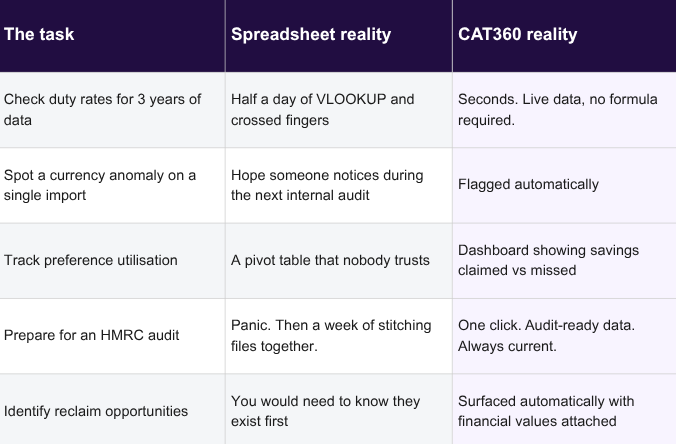
So what’s the alternative?
We built CAT360 because we kept seeing the same problem. Smart customs teams, doing good work, but drowning in spreadsheets that couldn’t keep up with the complexity of modern trade.
CAT360 enriches your CDS declaration data and turns it into something you can actually work with. Live dashboards, data consolidation. Automated variance checks. Preference tracking. Reclaim identification. Audit-ready data. All in one place, always current, no formulas required.
It doesn’t replace your expertise. It gives your expertise better tools.
Ready to see what your spreadsheet is hiding?
Book a demo of CAT360 and we’ll show you, using your own data, exactly where the gaps, risks, and savings are. No obligation, no jargon, just clarity.

Chief Commercial Officer